
Understanding the Basics of Property Managers Fees
If you own a residential property in the Minneapolis and Saint Paul metro area and are looking to hire a Property Manager to rent it out for the first time, the first question is often “How much does Property Management cost?”.
But if you’ve ever hired a Property Manager before, you know the number they quoted you at the start looks nothing like what appears on your year-end statement.
So before deciding if hiring a company to manage your rental property makes sense, it’s important to understand the total cost.
In this article we’ll calculate the true total cost of hiring a Property Manager by breaking down all the different types of fees they charge, , what those fees cover, and the average price range for those fees.
The Different Types of Fees Property Managers Charge
The Property Management industry in the Minneapolis & Saint Paul Metro has largely adopted the same pricing model. Which can be described and categorized as the Management Fees (base) & Add-on Fees (ancillary).
Category of Fees
- Management Fees (base) – these are the fees that are often marketed to you, like the Tenant Placement Fee & Monthly Management Fee
- Add-on Fees (ancillary) – these are the fees that are less discussed like maintenance surcharges, lease renewal fee, eviction handling, and property inspections.
To help you understand the total cost of Property Management, let’s break down the different fees in each category.
Common Fees: The Universal Property Management Fees
Nearly every Property Manager in the Minneapolis & Saint Paul Metro will have these two Base Fees as a part of their pricing.
Univerval Property Management Fees
- Tenant Placement Fee
- Monthly Management Fee
Let’s detail what these cover and break down the typical pricing range.
Tenant Placement Fees
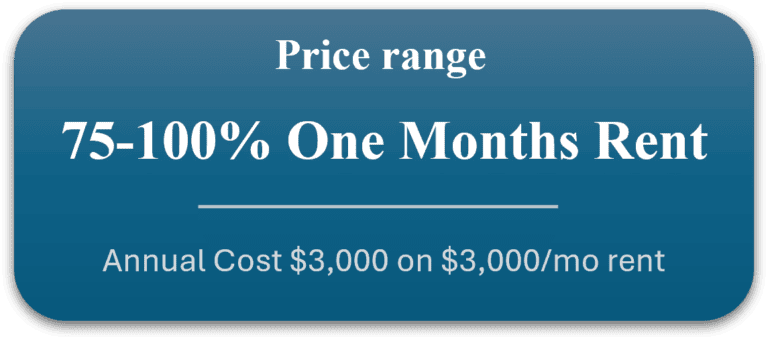
What this fee covers: marketing, photos, communicating with prospective tenants, scheduling and completing showings, answering questions, completing background checks, and executing a lease. Some companies offer Tenant Placement as a standalone offering.
Monthly Management Fee

What this fee covers: What’s covered in this fee can vary drastically by each Property Management Company. It’s safe to assume, the lower the monthly Management Fee, the less they’ll cover. But for the typical Property Manager, this fee covers the basic day-to-day operations of the property like collecting rent and communicating with the Tenant.
Add-on & Ancillary Fees and Surcharges: The Hidden Profit Killers
Ancillary Fees are the most important type of fee to consider when calculating the cost of Property Management and are often overlooked by owners because they are less predictable.
Here are the most common types of extra fees Property Managers charge owners in addition to the Management Fee.
Maintenance Markup Fees & Surcharges

Fee Overview: This fee is added on top of the vendors invoice. For a $1,0000 repair, you can expect to pay an additional $100-$200 in fees to the Management Company to compensate them for their time in coordinating the repair with the vendor, and communicating with the Tenant.
Lease Renewal Fees
Fee Overview: If the Tenant decided to renew the lease, the Property Manager would charge this fee. This fee covers analyzing current market rents, tenant communication, negotiations, and executing a lease new lease.
Administrative Onboarding Fee

Fee Overview: Often a one-time upfront fee charged the the Property Manager when onboarding a new client or property. This fee covers the administrative legwork it takes to onboard a new property for activities such as document verification, notifying tenants about management changes, and uploading property and owner information into their system.
Eviction Handling Fees

Fee Overview: In the event an eviction is necessary, this fee is billed to the owner to cover the Property Managers time during the eviction process. This does not include additional attorney or court filing fees.
Property Inspection Fee

Fee Overview: Most Management Companies don’t include inspections of the property during the Tenant’s stay. If you want a mid-lease inspection to be completed, they will charge this fee to go out and inspect the property.
Less Common Property Management Fees & Surcharges
In addition to the fees we just covered, these fees are adopted at a less often but still very common in Single Family Residential Property Management.
Administrative Fee
A general monthly surcharge for basic office overhead and document storage.
Technology Fee
A monthly cost for access to online portals and digital reporting software.
Material Markup
A surcharge added to the cost of basic supplies like paint, filters, or light bulbs.
Document Fee
Typically covers specialized reporting, such as the Certificate of Rent Paid (CRP) in Minnesota, and monthly statements.
Pet Administrative Fee
A fee charged to manage the additional risks and inspections required for households with animals.
Vacancy Fee
A type of fee charged to manage vacant properties.
Implicit vs Explicit Costs : What You Pay in Fees vs. What it Actually Costs You
Lost revenue and avoidable expenses have an equal impact to your profitability as fees paid to the Property Manager.
So, if you’re only calculating the fees to determine the total cost of hiring a Property Manager, then you’re missing half the equation.
The Two Types of Costs
- Explicit Costs – direct fees that show on your monthly statement
- Implicit Costs – in your year-end profit gap
Before running some numbers, let’s further expand on what Explicit and Implicit costs are.
Explicit Costs: "The Visible" Fees on Your Monthly Ledger
Explicit costs are direct expenses, most often associated with the fees charged by the property manager
Examples of Explicit Costs:
- Monthly Management Fees: ongoing day-to-day management of the property
- Tenant Placement Fees: charged to you to find and place a Tenant
- Maintenance Surcharges: added to vendor invoices
- Eviction Fee: charged to the owner in the event an eviction is necessary
These fees are typically more transparent and often easier to predict.
Implicit Costs: The "Invisible" Profit Killers Impacting Your NOI
Implicit costs often don’t show up on your statement as a fee, but as increased cost or loss revenue.
Examples of Implicit Costs:
- Extended Vacancy Time: revenue lost through vacancy as a result of turnover time
- Property Turn: the costs associated with turnovers
- Cost of Vendor Invoices: the amount you pay to vendors for repairs
- Emergency Maintenance: the repairs that result from deferred maintenance
While less visible, their impact on your profit is equal to Explicit Costs and the fee Property Manager’s charge.
The Math: Calculating the True Cost of Property Management
We’ve just covered the different types of fees that Property Managers in the Twin Cities typically charge, and the difference between Implicit and Explicit Costs.
Now let’s apply these to real-world scenarios and calculate the true cost of Property Management.
Scenarios:
- Cost For the First Year
- Cost for 2 Years if the Tenant Stays
- Cost for 2 Years if the Tenant Moves Out
- Cost of a Maintenance Emergency
For each scenario, we’ll calculate the Owners Implicit & Explicit costs and compare that to the revenue generated by the Property Management Company.
But first let’s meet our Owner & Property Manager.
The Property Owner
Sara had recently accepted a job out of state, but instead of selling her home in Bloomington, MN, she decided to rent it out.
She interviewed multiple Management Companies before selecting one to manage her Single Family House.
What’s Important to Sara:
- Total monthly fees
- Experience with Single-Family houses
- Predictable Cashflow
Property Details:
- Monthly Rent $3,250
- Single Family Home, 4 Bedroom 3 Bath, built in 1978
- Transitioning from Owner-Occupied to Rental
- Maintenance & Repairs $3,900 year (based on of 10% of gross rent)
Meet the Property Management Company
The company she decided was the best match for her had years of experience managing residential properties, minimal additional fees, and had the lowest monthly management fee.
Property Management’s Pricing Structure:
- Tenant Placement Fee – one month’s rent
- Monthly Management Fee – of $125/mo
- Maintenance Surcharge – of 10%
We’ll calculate our costs with only those three types of fees.
Year One: Breaking Down the Costs
Because Sara was moving out of her property and converting it to a Rental, her first-year costs were predictable.
Here are Sara’s costs compared to the revenue generated by her Property Manager during her first year.
| Fee Type | Fee Rate | 1/yr Cost to You | PM Revenue |
|---|---|---|---|
Tenant Placement Fee | One Month’s Rent | $3,250 | $3,250 |
Monthly Management Fee | $125/mo | $1,375 | $1,375 |
Maintenance Fee | 10% Surcharge | $390 | $390 |
TOTAL COST YEAR ONE | $5,015 | $5,015 |
Year Two Outcomes: Renewal vs. Turnover
After the first year there are two possible outcomes.
- The Tenant Stays and renews their lease for an additional year
- The Tenant Moves Out and decides against resigning the lease
Each scenario presents its own set of Implicit and Explicit costs for Sara, and different revenue opportunities for the Property Manager.
Year Two Cost: Tenant Re-signs the Lease
If the Tenant had decided to re-sign for another year and stay, these would be Sara’s Total Costs for the second year only, compared to the revenue generated by the Property Manager.
| Fee Type | Fee Rate | 2/yr Cost to You | PM Revenue |
|---|---|---|---|
Lease Renewal | $300 | $300 | $300 |
Management Fee | $125/mo | $1,500 | $1,500 |
Maintenance Fee | 10% Surchare | $390 | $390 |
TOTAL COST YEAR 2 ONLY | $2,190 | $2,190 |
Year Two Cost: Tenant Moves Out & Vacates the Property
Unfortunately for Sara, the Tenant decided to move out.
Thankfully the Tenant left the property in perfect condition, and the turnover process was exceptionally quick.
In other words, the perfect scenario for an Real Estate Investor.
Because of this, Sara only had $750 in turnover charges, and the property was vacant for only two weeks.
Had the Tenant left the property in average condition, the vacancy could have been up to 4 weeks, and the turnover costs could have been exponentially higher.
Here’s Sara’s cost compared to the Property Manager’s revenue for this outcome.
| Fee Type | Fee Rate | 1/yr Cost to You | PM Revenue |
|---|---|---|---|
Vacancy Backfill | One Month’s Rent | $3,250 | $3,250 |
Management Fee | $125/mo | $1,375 | $1,375 |
Maintenance Fee | 10% Surchare | $390 | $390 |
Property Turnover | Minimum | $750 | $0 |
Turnover Surcharge | 10% | $75 | $75 |
Property Vacancy | 2 Weeks | $1,625 | $0 |
TOTAL COST YEAR 2 ONLY | $7,465 | $5,090 |
These numbers should make it clear why Sara wanted the Tenant to renew their lease.
Her costs soared over 340% compared to had the Tenant resigned.
The Property Manager’s revenue increased 232%.
Could this fee discrepancy indirectly, or directly, incentivize the Property Managers behavior?
Maintenance Scenario: The Timeline & Impact
During the first year, Sara’s air conditioning unit went out at her rental property.
This is how it unfolded.

The Property Manager kept their promise and did what needed to be done and repaired the AC unit.
But at what cost?
Most owners see their Tenants as their customers, and a 2 week delay in repairing the AC unit wouldn’t have been acceptable. If you’re in this camp and believe Tenant experience is directly correlated to Tenant retention, this is not a good outcome.
Follow the Money: Side by Side Comparison of Two-Year Owners Costs vs. Property Management Revenue
Now let’s take both outcomes and compare them side by side.
Comparing the revenue of the Property Manager, and the costs Sara took on for both second year outcomes, who appears to be the winner?


When you compare both potential outcomes:
- Sara’s costs increased $5,275
- PM generated $2,900 more in Revenue.
And as a percent of rent the total rent collected compared to Sara’s total cost:
- 9.2% of rent collected had the Tenant stayed,
- 16.3% when then the Tenant moved out
So, Sara’s cost soared, but the Property Manager?
Their revenue increases.
For those who are looking to rent out their property for the first time, the conflict of interest between the Investor & the Property Manager is starting to become more apparent.
Why Transactional Fees Incentivize the Wrong Vendor Behavior
For Investors and Owners looking to hire a Property Manager for the first time, the scenario we just went over might leave you with some unanswered questions like:
- Why does it appear that Property Manager’s make more money when my costs go up?
- If they’re paid on a % of total spend for repairs and maintenance, wouldn’t they be negotiating against themselves to bid out the project for a lower cost?
- Is the reactive approach instead of a proactive approach a hidden cost not accounted for?
- Is the performance of my investment even relevant to them?
And those are all valid questions.
Setting Expectations: How this model may be working against you
The numbers don’t lie.
When the Owner’s costs go up, the Management Companies revenue increase.
We’re not making the argument that companies who adopt this fee structure are actively working against your interest. Even though it’s reasonable to see how anyone could come to that conclusion.
But even in the best case scenario, it’s clear they don’t have the structural incentive to care about the performance of your asset.
When a huge portion of your revenue is generated through ancillary fees, being reactive is the most profitable path.
And being proactive increases their costs while actively working against future opportunities to generate revenue.
If owners decide on this business model, they need to understand exactly what they’re signing up for.
These companies aren’t a partner working towards the same goal as you, the owner, have.
They are providing you a guarantee to keep your property functional, compliant, and operating. That’s it.
This business model works for some, but not for all.
Many owners care equally about their financial performance as much as keeping the property operational.
But most acknowledge that it’s impossible to separate optimizing their Net Operating Income, from the company they’ve hired to manage the day-to-day operations of the rental property.
Alternative Property Management Business Models for Owners
For owners who see the glaring conflict of interest between their goals and the typical Property Management Business model, there are alternative options out there.
Instead of a Property Management that operates like a tax sales tax on the property, some companies have adopted a model that rewards them for keeping your costs down.
For Property Management Companies like ECR Property Management who have adopted this model, they have to be confident in the value they bring. Because they often don’t recoup their initial costs for new owners for months.
Performance Based Fee Structure
The alternative to solving this conflict of interest, ECR Property Management has adopted a fee structure that aligns our incentives with yours as the owner.
By charging a fixed fee, or % of revenue, when you do better, so do we.
By adopting this model, it fundamentally shifts the paradigm from reacting to things that go wrong, to proactive working to prevent them.
The Final Comparison: Task-Based Bills vs. Shared Performance Success
Here’s an example.
In this scenario, the Property Management Company has adopted a simple 10% of total rent collect without all the additional fees and surcharges.
Had Sara decided to partner with a Property Manager who used this pricing model, this is what her 2-year cost would have looked like for both outcomes. Again, we’ll compare it to the revenue generated by the Property Manager


What was an opportunity for the Property Manager to generate profit from maintenance, turnovers, and vacancies, has now become a cost center to the management company.
Not only does their revenue decrease in the event the property becomes vacant, the Property Manager assumes the cost of labor for performing these tasks.
Looking at this scenario, what incentive do you think the Property Manager has?
Tied to Your Success: Why Outcome-Based Fee Management Always Wins
If you believe a bad Property Manager can negatively impact the profitability of your property, it’d be safe to assume the opposite. That a good Property Manger can increase it’s performance.
By partnering with a company that adopts the fixed fee/percent of rent fee structure, your chosing a partner working towards the same goals as you. Not one indifferent to the outcomes.
Now their success and profitability is direectly correlated to yours.
We built ECR Property Management because we experience first had how the typical Base + Ancillary fee model negatively impacted the performance of our portfolio.
If you own a Single Family or Small Multi-Unit Residential Property in Minneapolis & Saint Paul or anywhere in the surrounding metro area, and want to partner with a Management Company whose success is linked to yours, consider ECR Property Management for help managing your rental properties.